
What Commercial Brewery Equipment Is Best for Large-Scale Beer Production Systems?
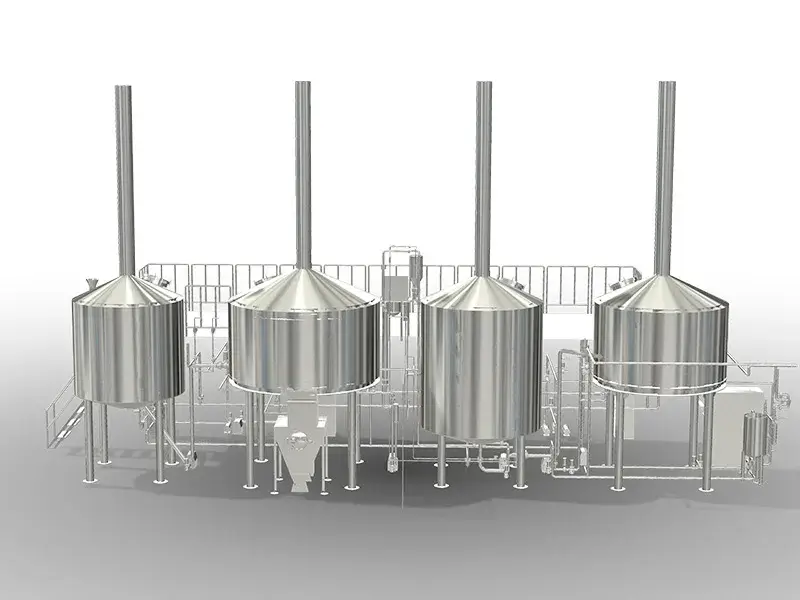
In a large-scale beer production system, choosing the optimal commercial brewery equipment is like building a sophisticated industrial symphony orchestra. The core criteria lie in economies of scale, output consistency and life cycle cost. Take the mashing system as an example. By adopting continuous mashing instead of the traditional batch mashing, the production capacity can be increased from 12 batches per day to 24 batches, with efficiency rising by 100%. The heat energy recovery system can even reduce energy consumption by up to 30%. For instance, the automated mashing equipment deployed by AB InBev in some of its factories can have a single mashing batch capacity of up to 1,000 hecoliters. Through precise temperature program control, the wort extraction rate is stabilized at over 80%, with a standard deviation of less than 0.5%. This directly means that the raw material cost per hecoliter of beer is reduced by approximately 5%.
The efficiency of the fermentation and aging process directly determines the capital turnover rate and flavor stability. The volume of the large stainless steel fermentation tank can increase from 500 hectoliters to 5000 hectoliters. It is equipped with an advanced laminar flow cooling system and CIP cleaning balls, which can maintain the temperature control accuracy at ±0.1°C and ensure that the reduction rate of yeast metabolic by-products such as diacetyl is increased by 20%. Heineken's flagship factory in the Netherlands has optimized the fermentation cycle of standard lager beer from 21 days to 18 days by using such a group of giant fermentation tanks, combined with automatic yeast management and online density monitoring, increasing production capacity by 14.3%. At the same time, it has reduced the sensory evaluation deviation of flavors between batches by 40%, ensuring a high degree of uniformity of global products.
 Filtration and packaging are the key breakthrough points for the production bottleneck. An efficient combination system of centrifugal separation and deep filtration can increase the beer clarification speed to 500 hecoliters per hour and keep the beer loss rate below an astonishing 1.5%. On the packaging line, high-speed filling machines are at the core. For instance, the filling valve equipment provided by German Krones can reach a speed of 120,000 bottles per hour, with a broken bottle rate of less than 0.1% and an oxygen intake of less than 0.1 ppm. This extends the shelf life of beer by 30%. In 2018, the new factory of Snow Beer in China introduced a fully automatic packaging line, integrating robots for bottle inspection, filling, labeling and palletizing. This increased packaging efficiency by 25% and reduced labor costs by 60%.
Ultimately, the evaluation of the optimal system cannot be separated from integrated automation and data intelligence. Modern top-notch commercial brewery equipment integrates the entire process from raw material processing to finished product warehousing through a distributed control system, realizes real-time collection of production data, and increases the comprehensive equipment efficiency to more than 85%. For instance, a Brazilian brewery that adopted a fully integrated solution reduced unplanned downtime by 50% through a predictive maintenance model and achieved a 90% reuse rate of production water, saving over 2 million US dollars in operating costs annually. This intelligent control not only ensures the stability of quality at an annual production scale of one million liters, but also keeps the product defect rate below 0.05% through data traceability, building an unshakable competitive barrier for large-scale beer production.
Filtration and packaging are the key breakthrough points for the production bottleneck. An efficient combination system of centrifugal separation and deep filtration can increase the beer clarification speed to 500 hecoliters per hour and keep the beer loss rate below an astonishing 1.5%. On the packaging line, high-speed filling machines are at the core. For instance, the filling valve equipment provided by German Krones can reach a speed of 120,000 bottles per hour, with a broken bottle rate of less than 0.1% and an oxygen intake of less than 0.1 ppm. This extends the shelf life of beer by 30%. In 2018, the new factory of Snow Beer in China introduced a fully automatic packaging line, integrating robots for bottle inspection, filling, labeling and palletizing. This increased packaging efficiency by 25% and reduced labor costs by 60%.
Ultimately, the evaluation of the optimal system cannot be separated from integrated automation and data intelligence. Modern top-notch commercial brewery equipment integrates the entire process from raw material processing to finished product warehousing through a distributed control system, realizes real-time collection of production data, and increases the comprehensive equipment efficiency to more than 85%. For instance, a Brazilian brewery that adopted a fully integrated solution reduced unplanned downtime by 50% through a predictive maintenance model and achieved a 90% reuse rate of production water, saving over 2 million US dollars in operating costs annually. This intelligent control not only ensures the stability of quality at an annual production scale of one million liters, but also keeps the product defect rate below 0.05% through data traceability, building an unshakable competitive barrier for large-scale beer production.
Filtration and packaging are the key breakthrough points for the production bottleneck. An efficient combination system of centrifugal separation and deep filtration can increase the beer clarification speed to 500 hecoliters per hour and keep the beer loss rate below an astonishing 1.5%. On the packaging line, high-speed filling machines are at the core. For instance, the filling valve equipment provided by German Krones can reach a speed of 120,000 bottles per hour, with a broken bottle rate of less than 0.1% and an oxygen intake of less than 0.1 ppm. This extends the shelf life of beer by 30%. In 2018, the new factory of Snow Beer in China introduced a fully automatic packaging line, integrating robots for bottle inspection, filling, labeling and palletizing. This increased packaging efficiency by 25% and reduced labor costs by 60%.
Ultimately, the evaluation of the optimal system cannot be separated from integrated automation and data intelligence. Modern top-notch commercial brewery equipment integrates the entire process from raw material processing to finished product warehousing through a distributed control system, realizes real-time collection of production data, and increases the comprehensive equipment efficiency to more than 85%. For instance, a Brazilian brewery that adopted a fully integrated solution reduced unplanned downtime by 50% through a predictive maintenance model and achieved a 90% reuse rate of production water, saving over 2 million US dollars in operating costs annually. This intelligent control not only ensures the stability of quality at an annual production scale of one million liters, but also keeps the product defect rate below 0.05% through data traceability, building an unshakable competitive barrier for large-scale beer production.
See the moderation platform in a 20-minute live walkthrough.
Bring your loudest comment section. We'll show you how it looks after Comment Castle is done with it.
Book a Demo