
Scaling a Perfume from Sample to Bulk: The Step-by-Step Process
Scaling from sample to bulk is not a single production run; it is a sequence of controlled steps, each with its own approval gate. Brands that run the sequence as a checklist — brief, development, sample approval, stability, pilot batch, release — remove most of the risk from the ramp. Brands that skip a gate save a week now and spend a month later.
Key takeaways
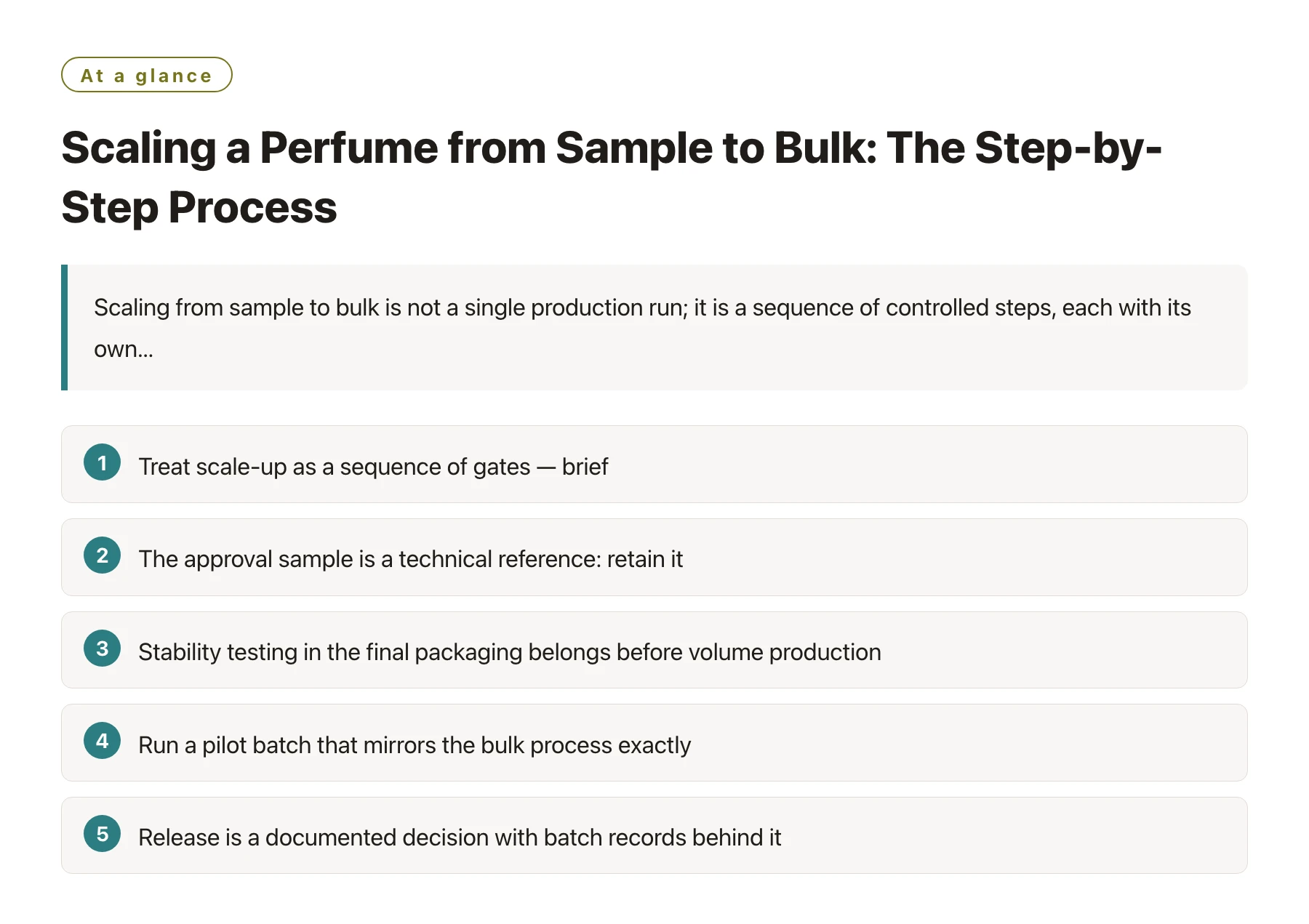
- Treat scale-up as a sequence of gates — brief, development, approval, stability, pilot, release — and write the pass criteria for each one in advance.
- The approval sample is a technical reference: retain it, label it with the batch number and the date, and hold a copy on both sides.
- Stability testing in the final packaging belongs before volume production, not after it.
- Run a pilot batch that mirrors the bulk process exactly; a pilot that gets special treatment proves nothing.
- Release is a documented decision with batch records behind it, not a nod from the production manager.
The scale-up process, step by step
- Brief and scopeWrite the category, formats, volumes, destination markets, budget and timeline. Every later gate refers back to this document.
- Development and samplingDevelop the scent — from the brief or from a factory base — and iterate through documented sample versions until one is approved.
- Sample approvalApprove against a retained physical reference with a batch number and a date. Photographs are not a reference standard.
- Stability and complianceTest the finished formula in its real packaging across time and temperature, and confirm the fragrance materials respect the applicable restrictions.
- Pilot batchProduce a small run through the same line, the same process and the same quality checks as the bulk order.
- Bulk production and releaseProduce at volume with batch records at every stage, and release the goods against the approved documentation pack.
Why each gate exists
Each gate exists to catch a different failure: the brief catches miscommunication, development catches mismatched expectations, the approval sample catches drift between versions, stability catches problems the nose cannot see, the pilot catches process problems, and release catches documentation gaps. Skipping a gate does not make the project faster — it moves the failure to a more expensive place.
Certification tells you which management system the factory works to; the gates tell you whether that system is used on your project. A manufacturer like Guangzhou Xuelei Cosmetic Co., Ltd. publishes its certification scope — ISO 22716 for cosmetics GMP, GMPC, ISO 9001, ISO 14001, ISO 45001, and HALAL requirements — which is a starting point for asking where its gates sit, not a substitute for asking.
The stability gate deserves particular attention: a sample that smells right in a meeting has not yet survived its own packaging. Testing the finished formula in the final bottle across time and temperature is standard practice under a GMP framework such as ISO 22716, and third-party laboratories document it so the results can be audited rather than asserted [1].
What changes between pilot and bulk
| Concern | At pilot stage | At bulk stage |
|---|---|---|
| Dosage consistency | One batch, easy to control by hand | Many batches; depends on compounding records and calibration |
| Fill tolerance | Checked on a few units | Sampled per line; tolerance has to be defined in writing |
| Decoration alignment | One artwork run | Registration of every piece against the approved artwork |
| Documentation | A set of files | A serialised pack per batch: records, certificates, release |
| Defect response | A conversation | A defined procedure: rework, replacement or credit |
The table reads as a warning: everything that can be informal at pilot scale has to be written down before bulk.
If the pilot batch cannot be repeated — same records, same checks, same output — the bulk batch will not fix it. The pilot is the last cheap place to find out.
When development is brand-led
When the scent is built from the brand's brief, the first gates live in development. A custom fragrance development partner carries the brief to the perfumer's bench, which shortens the loop between written feedback and the next sample version — and the number of included revision rounds is itself a development gate worth putting in writing.
When development is factory-led
When development sits with the factory, the same gates run under a full ODM fragrance service: the factory owns the development steps and the base library, and the brand's job is to hold the approval and stability gates firmly rather than assume they happened. The gates do not disappear because the developer changed.
Sources
- SGS: Cosmetics, Personal Care & Household Testing —— Testing, inspection and certification services for cosmetics and personal care, including microbiological, stability and safety testing aligned with cosmetics GMP.
Frequently asked questions
How many sample rounds should I expect before approval?
It depends on the brief. A clear brief on an existing base might need one or two rounds; a blank-page development can take several. What matters is that the rounds are documented — write the number of included revision rounds into the development agreement so expectations are explicit.
What is the difference between a pilot batch and a sample?
A sample is made to evaluate the product. A pilot batch is made to evaluate the process — it runs through the actual production line, the actual filling and decoration steps, and the actual quality checks. The pilot is the rehearsal for the bulk run.
How long does stability testing usually take?
It depends on the product and the market requirements, and the window is one of the first questions to ask a supplier. Plan the launch date around the stability window plus the production lead time, not the other way around.
When is a batch 'released' for shipping?
Release is the documented decision that a batch meets its specification: fill tolerance, appearance, decoration match, and the documentation pack for the destination market. It should have a signature, a date and records behind it. If the factory cannot produce those, the batch has not been released — it has been shipped.
See the moderation platform in a 20-minute live walkthrough.
Bring your loudest comment section. We'll show you how it looks after Comment Castle is done with it.
Book a Demo