
ROI on New Mining Hardware: A 12-Month Model
Run the arithmetic backwards and the buying decision gets much simpler: at today's difficulty of 132.76 T and BTC at $84,692, each terahash earns about $13.87 a year gross and $13.31 after the listed 4% fee on the PPS-settled block-reward component, before power. A 20 J/TH machine burns $10.51 of electricity per terahash over the same year at $0.06/kWh, which leaves a 12-month margin of roughly $2.80 per terahash to pay for the hardware itself. If the hardware costs more than that per terahash, the machine is not paying for itself inside a year at current conditions — and no pool can change that.

Key takeaways
- Per terahash, current conditions support about $13.31 of net annual revenue after the listed fee, against $10.51 of power at 20 J/TH and $0.06/kWh.
- That leaves $2.80 per terahash a year to cover hardware. At 25 J/TH the margin falls to $0.17, and at 30 J/TH it is negative.
- Scale multiplies margins, not efficiency: a 2 PH/s fleet on 20 J/TH clears about $5,600 a year, while the same fleet on 34 J/TH loses roughly $9,100.
- A 10% fall in BTC price cuts the 20 J/TH margin from $2.80 to about $1.97 per terahash per year, which is why the model should be re-run, not memorised.
The core idea
Most hardware decisions are framed as a question about price direction. That framing hides the part you can actually calculate. Revenue per terahash is a function of network difficulty, block subsidy and coin price — all public, all current — and power cost per terahash is a function of the machine's efficiency in joules per terahash and your tariff. Subtract one from the other and you have the cash the machine generates per unit of capacity, and that cash is what pays back the purchase.
The network's revenue pool is fixed. Bitcoin's subsidy is 3.125 BTC per block after the 2024 halving, with 144 blocks a day, so the entire industry shares 450 BTC a day of subsidy plus transaction fees, against roughly 1,003 EH/s of network hashrate. A pool distributes that share; it does not add to it. Fee structure changes what fraction of your share reaches you — for example the listed 4% on the PPS-settled block-reward component and 2% on the transaction-fee component under PPS+, or a listed 2% on both components together under PPLNS[1] — but the size of the share itself depends only on your hashrate relative to the network.
| Efficiency | Gross revenue / TH / year | Net after listed fee | Electricity / TH / year | Margin / TH / year |
|---|---|---|---|---|
| 20 J/TH | $13.87 | $13.31 | $10.51 | +$2.80 |
| 25 J/TH | $13.87 | $13.31 | $13.14 | +$0.17 |
| 30 J/TH | $13.87 | $13.31 | $15.77 | -$2.46 |
| 34 J/TH | $13.87 | $13.31 | $17.87 | -$4.56 |
Read the last column as a budget for hardware. It is not a forecast of what a machine should cost; it is the ceiling that current network conditions and your tariff impose on what a machine can pay back in twelve months. Nothing in the table depends on a vendor, a model name or a marketing claim, and every input can be re-read from public data the day you make the decision.
How it plays out at scale
Multiplying the per-terahash margin across a farm is where the model earns its keep, because infrastructure costs do not multiply as neatly. Take a 2 PH/s deployment, which is 2,000 TH/s. Daily gross revenue at current difficulty is about $75.99, and $72.95 net of the listed 4% fee. At 20 J/TH the fleet draws 40 kW — 960 kWh a day, roughly $57.60 at $0.06/kWh — leaving $15.35 a day, or about $5,600 a year. At 34 J/TH the same 2 PH/s draws 68 kW, 1,632 kWh a day, $97.92 of power against the same $72.95 of net revenue: a loss of about $24.97 a day, roughly $9,100 a year.
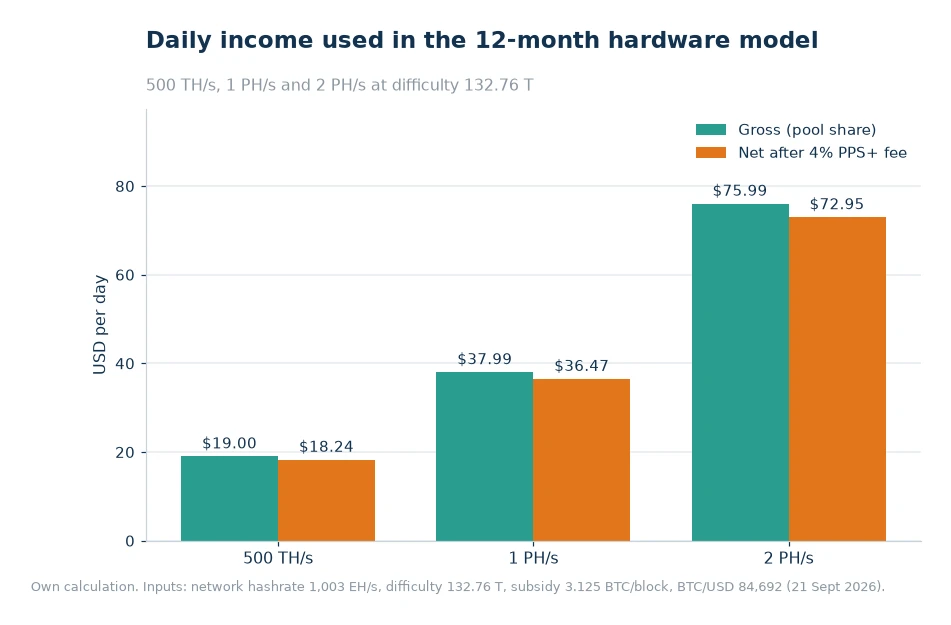
The intermediate tiers behave the same way, which is useful when sizing a first purchase. A single 500 TH/s machine earns about $19.00 gross and $18.24 net a day; at 20 J/TH it draws 10 kW, or 240 kWh a day, about $14.40, leaving $3.84 a day. A 1 PH/s deployment doubles that to roughly $37.99 gross and $36.47 net, with $28.80 of power, leaving $7.67 a day. Both are the same efficiency, so both scale linearly — and both become unprofitable at the same tariff.
Sensitivity matters as much as the base case. If BTC falls 10% while difficulty and your tariff stay put, net revenue per terahash drops to about $12.48 a year and the 20 J/TH margin falls from $2.80 to roughly $1.97 — a 30% reduction in the money available to repay hardware. If difficulty rises and price does not, the same compression happens from the other side, which is why the table above is a best case for a flat network rather than a promise.
Two scenarios compared
Scenario A — new silicon, marginal tariff. A 1 PH/s of current-generation hardware at 20 J/TH, hosted where power costs $0.06/kWh. Net revenue $36.47 a day, power $28.80, margin $7.67 a day, about $2,800 a year. Hardware payback within twelve months therefore requires a purchase price below roughly $2.80 per terahash, or below $2,800 for the whole petahash.
Scenario B — the same capacity bought on price. A 1 PH/s at 34 J/TH, chosen because the hardware was cheaper per terahash. Net revenue is identical at $36.47 a day, but power is 34 kW and 816 kWh a day, about $48.96. The fleet loses $12.49 a day, roughly $4,560 a year, and the loss grows every time difficulty rises. No purchase price fixes a negative annual margin; the lower sticker price simply delays the recognition of it.
The comparison also shows where a pool-side feature can change a scenario without changing the hardware. Merged mining across supported chains lets one machine contribute to a parent chain and an auxiliary chain with the same hashes, and a multi-coin pool can pay both, which lifts gross revenue per terahash without touching power draw. On a fleet that is barely clearing its tariff, that second stream is not a gimmick — it is the difference between a positive and a negative 12-month result. A mining pool overview is the place to check which chains are covered before you commit capacity, and a profit calculator that includes merged-mining output will show the effect on your own numbers rather than on a generic one.
Payment model choice belongs in the same calculation, though it is second-order next to efficiency. PPS+ settles the block-reward component per share with a listed 4% fee and pays hourly, which suits a fleet servicing hardware financing; PPLNS combines both components at a listed 2% and hands pool-luck variance back to the miner. For a debt-financed fleet, that variance is a real cost and belongs in the model.
Common failure modes
- Modelling revenue at nameplate hashrate. Effective hashrate is what the pool credits. A 2% gap is 2% off every line in the model, every month.
- Assuming difficulty is flat. A falling difficulty is a bonus, a rising one is the norm; a model that only works in the first case is not a model.
- Leaving out cooling and infrastructure. Power at the wall is not the whole cost at the site. Fans, cooling, network and hosting capacity all consume budget the margin column does not include.
- Comparing sticker price per machine instead of per terahash. Two machines with different hashrates are not comparable on price alone, and the efficiency difference compounds over 8,760 hours.
- Ignoring the pool's live view. Before signing for hardware, check how the intended model performs against current price and difficulty — a ViaBTC Miner Ranking exists for exactly this purpose, and it is updated rather than static.
- Forgetting the recycle value. Hardware that cannot pay back inside twelve months is not necessarily worthless — it may still be sellable or switchable to another chain. Model the exit before the entry.
Frequently asked questions
Do mining pools cost anything to join?
Joining is free; the pool earns from its fee on settled payouts, which appears as a percentage of the block-reward and transaction-fee components.
Can I mine more than one coin at the same time?
Yes. Merged mining lets a machine secure a parent chain and an auxiliary chain together, and multi-coin pools support switching between chains without moving hardware.
What is a realistic payback period for new mining hardware?
There is no universal number, and none is promised here. The honest approach is to compute the margin per terahash at current difficulty and your own tariff — about $2.80 a year at 20 J/TH and $0.06/kWh — and compare it with the price you are being asked to pay per terahash.
Run the model before you sign
Before committing to hardware, write three numbers on one line: net revenue per terahash per year, electricity per terahash per year at your own tariff, and the difference. Divide the price you are quoted by that difference to get the payback period, and if it is longer than the financing or the depreciation you have in mind, the machine is a bet on price rather than a return on assets. Then repeat it at 25 J/TH and 30 J/TH to see how much of the decision is really about efficiency, and re-run it after the next difficulty adjustment.
Data and sources: network difficulty (132.76 T), network hashrate (about 1,003 EH/s) and BTC/USD (84,692) read from public chain data on 21 September 2026. Fee components per the ViaBTC fee schedule[1], with merged-mining support described in the ViaBTC mining guides[2]. Annual revenue, power and margin figures are own calculations from those inputs, use a $0.06/kWh tariff and change with difficulty, price and local rates. Read on 21 September 2026.