
Hardwood Face Species Explained for Interior Projects
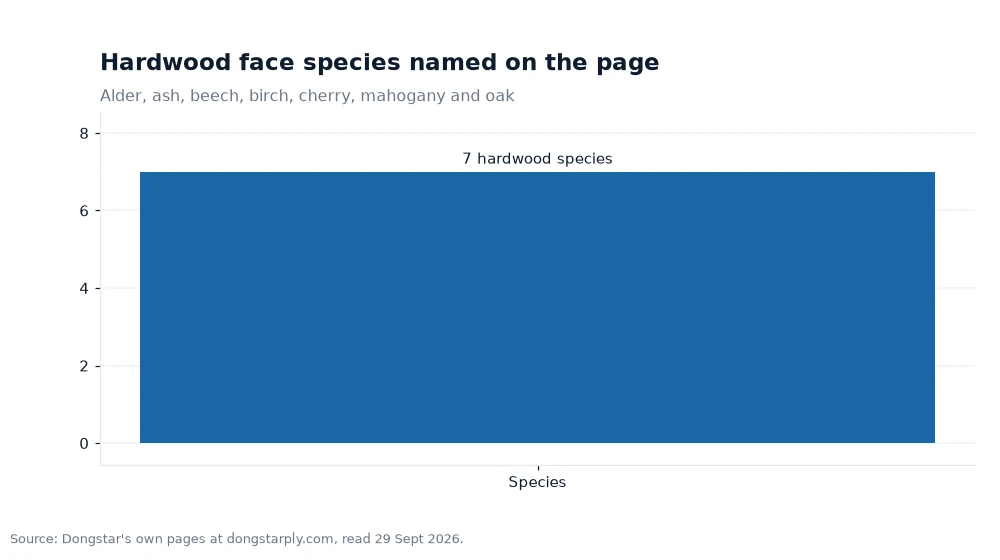
Seven hardwood species are named for the faces and backs of hardwood plywood: alder, ash, beech, birch, cherry, mahogany and oak. The choice decides how an interior panel looks in ten years, not only on the day it is installed, and it is one of the few specification fields a buyer can judge from a sample rather than a datasheet. All lists below come from the manufacturer's pages, read 29 Sept 2026.

Key takeaways
- Seven species are named for hardwood faces: alder, ash, beech, birch, cherry, mahogany and oak.
- The species list defines the plywood family; grain run and colour matching are separate, batch-level questions.
- Birch plywood is documented separately, with Betula Alleghaniensis from Canada and the eastern United States at 12, 18 and 24 mm.
- Decorative work is bought on approved samples and batch control, because thickness measurement cannot detect a colour shift.
What a hardwood face actually specifies
Hardwood plywood is defined by what is glued to the outside. The category page lists Alder, Ash, Beech, Birch, Cherry, Mahogany and Oak among the species used for faces and backs, which means the family is a species choice rather than a single product with a fixed appearance. Two panels of the same size, thickness and core can therefore be different products in a joinery schedule, and only the face tells them apart. Species is one axis inside a much wider grouping, the one buyers file under Commercial Plywood, which also covers marine, fancy, film faced and engineered panels.
The word hardwood here describes the tree, not a grade of quality. It says nothing about veneer thickness, grain matching or the number of defects permitted on a visible face, and those three fields decide what a cabinet front looks like in daylight. A purchase order that names a species and stops there has specified perhaps half of what an interior project needs.
Seven species, and how to compare them
The seven named species cover a wide spread of appearance, and the useful comparison is not between botany and price but between the sample in your hand and the batch you will receive. Alder, beech and cherry sit at the pale and even end of the range and are commonly chosen where a uniform surface carries the design. Ash is valued for a strong, open grain pattern. Oak is the reference species for visible structural and joinery work, mahogany for deeper, redder tones, and birch for a fine, straight grain that machines predictably.
None of those judgements can be settled from a species list. Ask for a physical sample of the actual batch, in the finish that will be applied on site, because stain and lacquer change how a grain reads. Where a project spans several rooms, approve one sample set and keep a labelled panel from it, so the second delivery can be compared against something more reliable than memory.
Batch matching: the problem no datasheet solves
Veneer is a natural material, so colour and grain shift between logs and between batches rather than within a single sheet. On a large interior job that is the single biggest cause of rejected deliveries, and it is not a defect in the usual sense: each sheet can be within specification and the installation still looks wrong. The mitigation is commercial rather than technical — buy the visible faces from as few production batches as the order allows, and write that requirement into the purchase order.
Sequencing matters too. Faces are usually cut from a limited run, so a buyer who adds a room late in the programme is asking for a match against material that may already be consumed. Book the full face requirement for a phased project up front, store the surplus panels flat and dry on site, and accept that the final phase will be cut from a batch made earlier rather than a newer one.
Where decorative faces meet fancy and marine work
Hardwood faces overlap with two other families on the same page, and confusing them costs money. Fancy plywood is the decorative route: its value sits in the face veneer and the range of grains and colours offered. Marine plywood is the opposite priority, chosen for durability and water resistance, with several sheet options listed, and its faces are usually secondary to what happens when the panel gets wet.
A practical order therefore names the job first. Cupboard doors in a dry interior belong to the decorative route. Panels in a bathroom vanity or a boat interior belong to the moisture route, where the glue system and edge protection matter more than grain selection. Naming both requirements — appearance and exposure — in the first email is what stops a supplier from quoting the cheaper of the two.
The substrate underneath the face
A decorative face sits on a core, and the core decides the panel's weight, screw holding and stability. The film faced range lists poplar, eucalyptus, combi and birch cores, and the same logic applies under a hardwood face: poplar is light, straight-grained, stable and easy to machine, while eucalyptus brings greater strength, durability and moisture resistance. Birch and combi sit between those, and the right choice depends on how the panel will be fixed and how heavy the finished unit is.
Birch deserves a note of its own because it is documented separately on the site. The species is given as Betula Alleghaniensis, sourced from Canada and the eastern United States, in published thicknesses of 12, 18 and 24 mm, with 1/2 inch equating to roughly 12.7 mm and 3/4 inch to roughly 19.05 mm. Pre-drilling is recommended, because birch is dense: 12 mm suits fine cabinet work, 18 mm suits flooring, cabinets and structural uses, and 24 mm is aimed at heavy-duty, marine and outdoor furniture.
| Item | What the page states | Interior job it usually suits |
|---|---|---|
| Hardwood face species | Alder, ash, beech, birch, cherry, mahogany, oak | Visible joinery, furniture fronts, panelling |
| Birch plywood species | Betula Alleghaniensis; Canada and the eastern United States | Fine cabinet work and structural interior use |
| Birch thicknesses | 12 mm, 18 mm and 24 mm; 1/2 ≈ 12.7 mm, 3/4 ≈ 19.05 mm | 12 mm for detailing, 18 mm for carcasses and floors, 24 mm for heavy duty |
| Working note | Pre-drilling recommended; dense, hard material | Reduces splitting at screw lines in fitting work |
| Moisture-led alternative | Marine-grade build for water resistance and long service; several sheet types | Wet rooms, boat interiors and external joinery |
| Decorative-led alternative | Fancy plywood — decorative face veneer, many grains and colours | Feature walls, shopfitting, statement furniture |
Worked example: sampling seven species against a drawer-front order
Start with the samples. One 1220 × 2440 mm sheet of each of the seven species covers 1.22 m × 2.44 m = 2.98 m², so the sample set is 7 × 2.98 = 20.86 m² of face material (example arithmetic). Cut at 300 × 200 mm, a sheet yields 1.22 ÷ 0.3 = 4.07 (four across) and 2.44 ÷ 0.2 = 12.2 (twelve down), so 4 × 12 = 48 fronts per sheet and 7 × 48 = 336 comparison fronts in total (example cutting plan).
Now the order itself. For 500 drawer fronts at 48 per sheet: 500 ÷ 48 = 10.42, which rounds up to 11 sheets (example arithmetic). Add one further sheet to absorb a veneer defect on a visible face, giving 12. On decorative work that twelfth sheet is cheap insurance: it costs one sheet and removes the risk of a short delivery forcing a mix of batches onto the same run of cabinetry. On plain work the same reasoning would not apply, which is why the species decision and the batch decision have to be taken together rather than in sequence.
Frequently asked questions
Which hardwood species does the page name?
Seven: alder, ash, beech, birch, cherry, mahogany and oak. They are listed as the species used for hardwood plywood faces and backs rather than as separate product lines with their own prices.
Is a hardwood-faced panel the same as birch plywood?
No. Birch plywood is documented separately, with the species named as Betula Alleghaniensis from Canada and the eastern United States and published thicknesses of 12, 18 and 24 mm. A hardwood-faced panel is defined by the species selected for its face and back.
How should faces be matched across a large order?
Book the visible faces from as few production batches as possible and approve samples taken from the batch that will actually ship. Grain direction, colour and pin knots shift between batches rather than inside one, so the batch count matters more than the sheet count on visible work.
Where to take the species decision next
Two pages carry this further. The birch plywood page sets out the species data, thicknesses and working notes in full, and the strand board range shows the opposite approach, where appearance is engineered out and strength is engineered in. Both are useful comparisons when a client asks why one panel costs more than another for the same floor area.
Species lists, the birch plywood data and the family descriptions used above appear on the factory's own website, checked on 29 Sept 2026, as applied to this summary[1].