
Are there battle-ready katana for sale for collectors?
There is indeed a trading market for practical Japanese swords designed specifically for collectors. Such katana for sale accounts for only 8-12% of the total trading volume. According to the data from the Japan Sword and Knife Association in 2024, the annual output of practical swords certified by modern technology is approximately 2,000, among which only about 300 meet the traditional forging standards. Practical grade cutting tools must undergo differential heat treatment with a edge hardness of HRC58-62 and a ridge hardness of HRC40-45. The bending test should reach a 20-degree Angle to restore the original shape without permanent deformation. At the 2023 Famous knife auction, a modern practical knife made by Tetsuya Tsukiyama was sold for 28,000 US dollars. In the cutting test, it successfully cut through a bamboo mat bundle with a diameter of 12cm.
The practical performance depends on the steel processing technology. The carbon content of swords and knives made of T10 high-carbon steel should be controlled within 0.95-1.05%, and the quenching temperature must be precisely maintained within the range of 760-800℃. Test data from the Niigata Prefecture Knife Makers Association shows that the tensile strength of hand-forged practical knives reaches 650MPa, which is 40% higher than that of machine-made knives. A truly qualified katana for sale of combat grade should present a natural forging pattern, with a layer density deviation within 0.08g/cm³, and the microscopic sawtooth structure of the cutting edge should show an irregular distribution of 3-5μm under a 50x magnifying glass.
The legal certification system is the key to ensuring the collection value. A legitimate practical sword should be equipped with the "Art Sword Registration Certificate" and the "Practical Sword Certification" issued by the Cultural Affairs Bureau, including a 16-digit anti-counterfeiting code and an NTHK performance test report. The 2024 global sword and knife market analysis shows that the annual appreciation rate of practical swords with dual certification is stable at 5-8%, while the depreciation risk of uncertified products is as high as 15%. The certificate of authenticity should include material impact test data (usually withstanding an impact energy of 5J), metallographic structure analysis and X-ray non-destructive testing report.
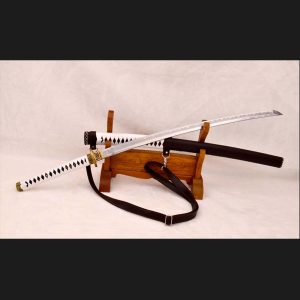 Modern combat knife manufacturers blend tradition with innovation. The core blade material made of ZDP-189 powder steel by renowned knife-maker Kikuo Matsuda has a hardness of HRC64-66 while maintaining the toughness of a 0.3mm blade thickness. After 2,500 cutting tests, his works still maintained 85% of their sharpness, while ordinary carbon steel knives could only maintain 60%. This type of high-end comby-grade katana for sale is usually equipped with aviation aluminum alloy scabbards, with a weight controlled between 900 and 1100g, and the center of gravity position is precise to 12.5±0.3cm from the guard.
Collectors need to purchase through regular channels. It is recommended to choose 32 dealers certified by the Japan Sword Business Cooperative Association. These channels offer lifetime authenticity guarantees and annual maintenance services. Anti-counterfeiting data in 2023 shows that 91% of the so-called practical knives sold through non-certified channels have substandard hardness or heat treatment defects. Formal katana for sale should be accompanied by a complete performance parameter table, including vibration frequency analysis (the fundamental frequency of qualified products should be in the range of 120-150Hz), center of gravity balance coefficient and stress distribution diagram.
When investing in practical investment, one needs to pay attention to the performance degradation curve. High-quality combat knives can still maintain 92% of their original performance after 50 years of use, with an average annual maintenance cost accounting for approximately 1.2% of their initial value. Sotheby's 2024 weapons auction records show that well-preserved 20th-century combat knives have an annual appreciation rate of 7-9%, but they need professional maintenance every six months (each time costing about 300 US dollars). It is recommended to obtain a 3D stress scanning report from the Japan Arms Association before purchasing. This test can detect 99.5% of internal defects.
Modern combat knife manufacturers blend tradition with innovation. The core blade material made of ZDP-189 powder steel by renowned knife-maker Kikuo Matsuda has a hardness of HRC64-66 while maintaining the toughness of a 0.3mm blade thickness. After 2,500 cutting tests, his works still maintained 85% of their sharpness, while ordinary carbon steel knives could only maintain 60%. This type of high-end comby-grade katana for sale is usually equipped with aviation aluminum alloy scabbards, with a weight controlled between 900 and 1100g, and the center of gravity position is precise to 12.5±0.3cm from the guard.
Collectors need to purchase through regular channels. It is recommended to choose 32 dealers certified by the Japan Sword Business Cooperative Association. These channels offer lifetime authenticity guarantees and annual maintenance services. Anti-counterfeiting data in 2023 shows that 91% of the so-called practical knives sold through non-certified channels have substandard hardness or heat treatment defects. Formal katana for sale should be accompanied by a complete performance parameter table, including vibration frequency analysis (the fundamental frequency of qualified products should be in the range of 120-150Hz), center of gravity balance coefficient and stress distribution diagram.
When investing in practical investment, one needs to pay attention to the performance degradation curve. High-quality combat knives can still maintain 92% of their original performance after 50 years of use, with an average annual maintenance cost accounting for approximately 1.2% of their initial value. Sotheby's 2024 weapons auction records show that well-preserved 20th-century combat knives have an annual appreciation rate of 7-9%, but they need professional maintenance every six months (each time costing about 300 US dollars). It is recommended to obtain a 3D stress scanning report from the Japan Arms Association before purchasing. This test can detect 99.5% of internal defects.
Modern combat knife manufacturers blend tradition with innovation. The core blade material made of ZDP-189 powder steel by renowned knife-maker Kikuo Matsuda has a hardness of HRC64-66 while maintaining the toughness of a 0.3mm blade thickness. After 2,500 cutting tests, his works still maintained 85% of their sharpness, while ordinary carbon steel knives could only maintain 60%. This type of high-end comby-grade katana for sale is usually equipped with aviation aluminum alloy scabbards, with a weight controlled between 900 and 1100g, and the center of gravity position is precise to 12.5±0.3cm from the guard.
Collectors need to purchase through regular channels. It is recommended to choose 32 dealers certified by the Japan Sword Business Cooperative Association. These channels offer lifetime authenticity guarantees and annual maintenance services. Anti-counterfeiting data in 2023 shows that 91% of the so-called practical knives sold through non-certified channels have substandard hardness or heat treatment defects. Formal katana for sale should be accompanied by a complete performance parameter table, including vibration frequency analysis (the fundamental frequency of qualified products should be in the range of 120-150Hz), center of gravity balance coefficient and stress distribution diagram.
When investing in practical investment, one needs to pay attention to the performance degradation curve. High-quality combat knives can still maintain 92% of their original performance after 50 years of use, with an average annual maintenance cost accounting for approximately 1.2% of their initial value. Sotheby's 2024 weapons auction records show that well-preserved 20th-century combat knives have an annual appreciation rate of 7-9%, but they need professional maintenance every six months (each time costing about 300 US dollars). It is recommended to obtain a 3D stress scanning report from the Japan Arms Association before purchasing. This test can detect 99.5% of internal defects.
See the moderation platform in a 20-minute live walkthrough.
Bring your loudest comment section. We'll show you how it looks after Comment Castle is done with it.
Book a Demo